
SKILLED TRADES TECHNICAL TRAINING
Build Technicians Who Understand the Work — Not Just the Steps.
Technical excellence looks different in every trade, but the fundamentals of developing great tradespeople are remarkably consistent.
They need to understand the systems they work on.
They need to know how to use their tools and instruments correctly.
They need to recognize when something isn't operating as intended.
They need to troubleshoot systematically.
They need to perform quality work safely.
And they need to verify the result before calling the job complete.
Precision provides practical technical and field-development programs for skilled-trade organizations, including:
HVAC & Mechanical
Plumbing & Hydronics
Electrical
Facilities & Building Maintenance
Construction & Installation
Commercial Service
Industrial & Specialty Trades
Training programs can be customized around your company's trade, equipment, workforce, procedures, and technical-development needs.
SKILLED TRADES TECHNICAL TRAINING
Build Technicians Who Understand the Work — Not Just the Steps.
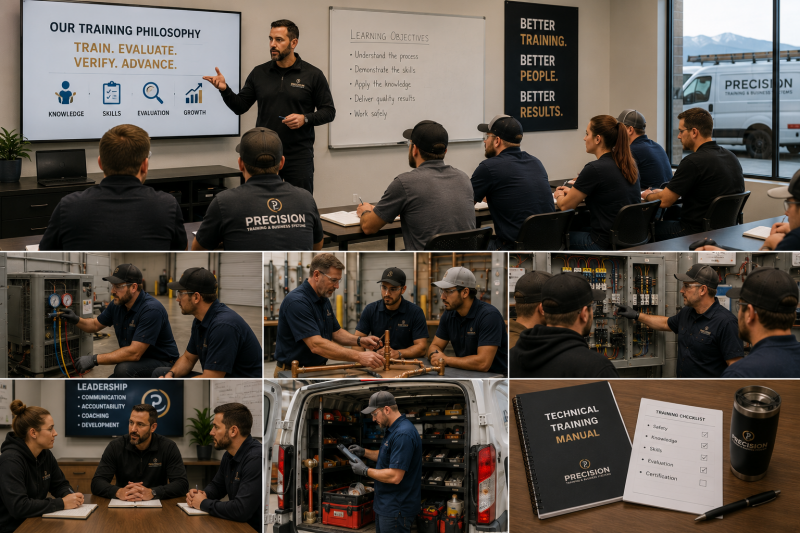
Technical excellence looks different in every trade, but the fundamentals of developing great tradespeople are remarkably consistent.
They need to understand the systems they work on.
They need to know how to use their tools and instruments correctly.
They need to recognize when something isn't operating as intended.
They need to troubleshoot systematically.
They need to perform quality work safely.
And they need to verify the result before calling the job complete.
Precision provides practical technical and field-development programs for skilled-trade organizations, including:
HVAC & Mechanical
Plumbing & Hydronics
Electrical
Facilities & Building Maintenance
Construction & Installation
Commercial Service
Industrial & Specialty Trades
Training programs can be customized around your company's trade, equipment, workforce, procedures, and technical-development needs.
DIAGNOSTICS & TROUBLESHOOTING
Stop Guessing. Start Diagnosing.
Whether the problem involves an HVAC system, electrical circuit, plumbing system, pump, control, mechanical assembly, or building system, effective troubleshooting starts with a disciplined process.
Precision teaches technicians to slow the problem down and work systematically.
THE PRECISION DIAGNOSTIC PROCESS
1. Understand the complaint.
What is the customer, operator, or employee actually reporting?
2. Verify the problem.
Never begin with an assumption. Confirm the condition whenever possible.
3. Understand how the system should operate.
Know the intended sequence, function, or expected condition before deciding what's wrong.
4. Gather meaningful information.
Inspect. Measure. Test. Observe.
5. Develop possible causes.
Use the evidence to narrow the possibilities.
6. Test the possibilities.
Choose measurements and tests that prove or eliminate potential causes.
7. Identify and prove the failure.
Don't replace something simply because it seems likely.
8. Correct the problem.
Complete the repair or corrective action using appropriate procedures.
9. Verify proper operation.
Confirm the original problem is resolved and the system is operating as intended.
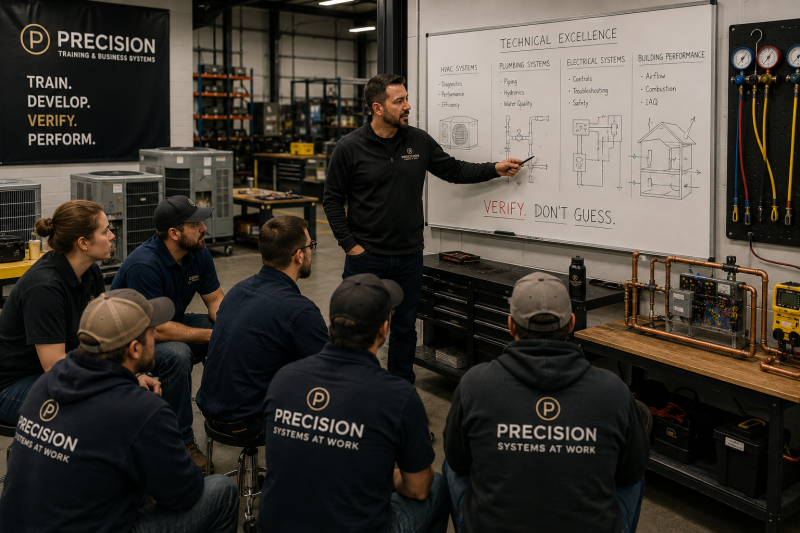
VERIFY. DON'T GUESS.
That's not just an HVAC principle.
It's a skilled-trades principle.
TRADE-SPECIFIC DEVELOPMENT
Technical training can be developed around the systems your employees actually work with.
HVAC & MECHANICAL
-Electrical diagnostics
-Refrigeration
-Airflow
-Heating and cooling systems
-Heat pumps
-Controls
-Combustion
-Hydronics
-Preventive maintenance
-Systematic troubleshooting
PLUMBING & HYDRONICS
-Plumbing fundamentals
-Water distribution
-Drain, waste, and vent systems
-Water heaters
-Tankless systems
-Pumps
-Hydronic systems
-Valves and controls
-Service diagnostics
-Preventive maintenance
ELECTRICAL
-Electrical fundamentals
-Meters and testing
-Circuit diagnostics
-Controls
-Motors
-Relays and contactors
-Transformers
-Sensors
-Wiring diagrams
-Electrical troubleshooting
-Safe work practices
FACILITIES & BUILDING SYSTEMS
-Preventive maintenance
-Mechanical systems
-Electrical systems
-Plumbing systems
-Building equipment
-Pumps and motors
-Controls
-Equipment inspections
-Troubleshooting
-Maintenance documentation
CONSTRUCTION & INSTALLATION
-Installation standards
-Plans and specifications
-Jobsite organization
-Quality control
-Material handling
-Documentation
-Equipment and tool use
-Safety practices
-Inspection readiness
-Workmanship standards
SPECIALTY TRADES
Not every skilled-trade company fits neatly into one category.
Precision can work with organizations to identify their technical competency requirements and develop training programs around the equipment, systems, procedures, and standards their employees are responsible for.
FROM APPRENTICE TO EXPERT
Technical Development Should Have a Path.
Employees should know what they need to learn, what they need to demonstrate, and what is required to advance.
Precision can help companies develop structured technical career paths using:
Competency matrices
Employee levels
Written assessments
Practical evaluations
Field observations
Training requirements
Qualification standards
Continuing education
Advancement criteria
Manager sign-offs
Instead of advancement being based primarily on time employed, technical development becomes based on demonstrated capability.