

RESULTS
Better Business Systems Should Produce Better Business Results.
Precision isn't interested in creating systems simply so a company can say it has them.
An SOP only matters if people use it.
Training only matters if performance improves.
A KPI only matters if leadership acts on it.
A management system only matters if it creates greater clarity, accountability, and control.
That's why Precision approaches every engagement with the same question:
WHAT SHOULD BE DIFFERENT WHEN WE'RE DONE?
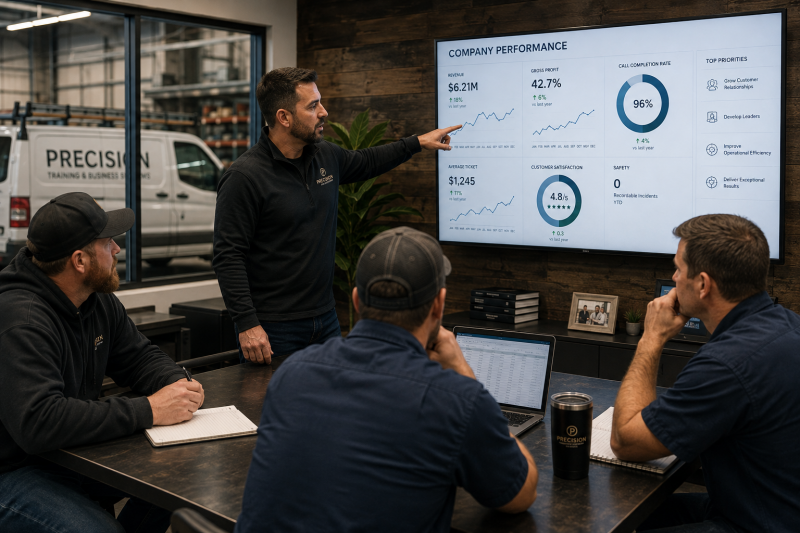
WE MEASURE IMPLEMENTATION —
NOT ACTIVITY.
It's easy to measure consulting activity.
Meetings held.
Documents created.
Training hours completed.
Policies written.
Those things may be necessary, but they aren't the result.
The real questions are:
Are employees following the new process?
Are managers actually holding people accountable?
Are problems being solved at the appropriate level?
Is training producing more capable employees?
Are operational problems occurring less frequently?
Does leadership have better information?
Is the company becoming less dependent on individual people?
THAT'S WHERE WE LOOK FOR RESULTS.
WHAT SUCCESS CAN LOOK LIKE
Every company begins from a different starting point.
The specific measures used during an engagement depend on the organization's goals, challenges, industry, and available data.
Precision may help clients establish and monitor improvements across several areas.
LEADERSHIP & ACCOUNTABILITY
A stronger organization should create greater clarity around who owns what.
We may evaluate:
Defined leadership responsibilities
Decision-making authority
Management follow-through
Meeting effectiveness
Completion of assigned priorities
Employee coaching activity
Performance-review consistency
Supervisor development
Internal leadership capability
THE GOAL:
Fewer decisions unnecessarily reaching ownership and greater accountability throughout the organization.
PEOPLE & WORKFORCE DEVELOPMENT
Training should create capability—not just attendance.
We may measure:
Employee training completion
Technical qualification levels
Assessment results
Advancement through career paths
New-hire development
Time to competency
Employee retention
Internal promotions
Performance-review results
Required certification completion
THE GOAL:
A more capable workforce with clearer expectations and a defined path for development.
OPERATIONAL CONSISTENCY
Strong systems reduce unnecessary variation.
Depending on the organization, we may monitor:
SOP implementation
Process compliance
Quality-control results
Rework
Callbacks
Documentation quality
Inspection results
Job completion standards
Workflow performance
Recurring operational problems
THE GOAL:
Make excellent performance repeatable instead of dependent on individual employees.
CUSTOMER EXPERIENCE
Customers should receive a consistent experience regardless of which employee represents the company.
Measures may include:
Customer satisfaction
Customer complaints
Callback trends
Response times
Communication standards
Documentation quality
Review trends
Follow-up completion
Service consistency
THE GOAL:
Protect the reputation that helped build the company in the first place.
SAFETY
Safety systems have to exist beyond the policy manual.
Organizations may monitor:
Training completion
Safety observations
Inspection results
Near-miss reporting
Incident trends
Corrective-action completion
Required documentation
Vehicle incidents
PPE compliance
Safety-meeting participation
THE GOAL:
Build safety into everyday operations and management accountability.
FLEET, TOOLS & INVENTORY
Company assets should be managed intentionally.
Measures may include:
Vehicle inspection completion
Preventive maintenance compliance
Fleet downtime
Tool losses
Inventory variance
Stockouts
Emergency purchasing
Truck-stock compliance
Warehouse accuracy
Asset accountability
THE GOAL:
Greater control over the resources required to operate the business.
MANAGEMENT INFORMATION
Leadership can't effectively manage what it can't see.
Precision may help establish:
Company scorecards
Department KPIs
Leadership dashboards
Employee performance metrics
Operational reporting
Quality metrics
Weekly scorecards
Quarterly priorities
Trend reporting
Management review cadence
THE GOAL:
Give leadership useful information early enough to make better decisions.
BEFORE. DURING. AFTER.
Establish the Starting Point.
Where reliable information is available, Precision begins by understanding current performance.
That gives us a baseline.
Not every company has perfect historical data.
That's okay.
Sometimes one of the first improvements is simply establishing a reliable way to measure what's happening.
Implement the System.
We establish the process, define responsibility, train the people involved, and begin using the system.
Implementation is monitored rather than assumed.
Measure the Result.
Once the system is operating, we evaluate whether it's producing the intended outcome.
If it isn't, we don't defend the system simply because we created it.
WE IMPROVE IT.
RESULTS AREN'T ALWAYS A BIGGER NUMBER.
Growth matters.
Profitability matters.
Revenue matters.
But not every meaningful improvement appears immediately on a financial statement.
Success can also look like:
An owner taking a vacation without constantly answering the phone.
A supervisor handling a personnel issue without escalating every decision.
A new employee receiving the same structured training as the employee hired before them.
A technician diagnosing a problem systematically instead of replacing parts until something works.
A warehouse employee knowing exactly what inventory needs to be reordered.
A manager opening a dashboard and knowing where the department needs attention.
An experienced employee's knowledge becoming part of the company's training system.
A leadership meeting ending with clear owners and deadlines.
An employee knowing exactly what they need to accomplish to earn their next promotion.
THOSE ARE BUSINESS RESULTS TOO.
FROM
'OWNER-DEPENDENT'
TO
'SYSTEM-DRIVEN'
_______________________________________________________________________________________________________
Ultimately, Precision is trying to help move the organization along a continuum.
_________________________________________________________________
OWNER-DEPENDENT
Knowledge lives primarily with ownership and key employees.
↓
DOCUMENTED
Critical expectations and processes are captured.
↓
TRAINED
Employees understand the systems and expectations.
↓
IMPLEMENTED
The systems become part of everyday operations.
↓
MEASURED
Leadership can determine whether they're working.
↓
MANAGED
Managers reinforce standards and correct problems.
↓
IMPROVED
The organization continuously strengthens its systems.
↓
SYSTEM-DRIVEN
The company benefits from strong leadership without requiring ownership to personally manage every detail.
Information
OUR STANDARD FOR A SUCCESSFUL ENGAGEMENT
At the end of a Precision OS™ implementation, we want the client to be able to answer four questions.
DO OUR PEOPLE KNOW WHAT'S EXPECTED?
DO OUR MANAGERS KNOW WHAT THEY OWN?
DO WE HAVE SYSTEMS FOR HOW CRITICAL WORK GETS DONE?
CAN WE TELL WHETHER THOSE SYSTEMS ARE WORKING?
If the answer to those questions is increasingly yes, the organization is moving in the right direction.
CASE STUDIES
Real Results. Documented Honestly.
As Precision engagements are completed, this section will feature documented client case studies showing:
The Starting Point
What challenges existed before implementation?
What We Built
Which systems were introduced?
How We Implemented It
How were leadership and employees involved?
What Changed
What measurable improvements occurred?
What We Learned
What worked, what needed adjustment, and what should happen next?
We believe results should be demonstrated with real information—not generic claims.
VERIFY. DON'T GUESS.
That standard applies to our own work too.
WHAT COULD BETTER SYSTEMS CHANGE IN YOUR BUSINESS?
Maybe the problem isn't that your company needs more people.
Maybe the people you already have need clearer systems.
Maybe the problem isn't that your managers don't care.
Maybe nobody ever taught them how to manage.
Maybe the problem isn't growth.
Maybe your infrastructure simply hasn't caught up with it yet.
That's what the first conversation is designed to uncover.
LET'S FIND OUT WHAT'S ACTUALLY HOLDING THE BUSINESS BACK.
PRECISION TRAINING & BUSINESS SYSTEMS
Systems. Leadership. Performance. Results.